What Is Hypothecation? Meaning, Examples & vs Mortgage
❤️ Spread the Love
The hypothecation meaning is straightforward: a movable asset backs a loan, but possession stays with the person borrowing. A car, delivery vehicle or business machine can provide security without being handed over.
This makes it a form of secured loan. The asset serves as collateral, giving the lender a legally recognised interest in it until the secured obligations are discharged.
Ownership and a security interest are different things. You generally remain the owner, while the finance provider holds rights under the agreement. Those rights can restrict a sale or transfer during the loan period.
The practical point is that you can continue using the asset, but it remains tied to repayment.
How hypothecation works
Hypothecation in loan agreements usually follows this sequence:
1. The asset is assessed. The lender evaluates the proposed security, your repayment capacity and the amount it can offer.
2. The agreement creates a charge. It identifies the asset and explains repayment terms, restrictions and recovery rights.
3. You keep using the asset. You pay each EMI and meet conditions such as maintaining insurance, where required.
4. The security is released after closure. Once all secured dues are cleared, obtain the relevant release documents and complete any required record updates.
If repayment fails, the lender may enforce its rights through the applicable process. Repossession is subject to contractual and legal requirements; it is not an unrestricted right to take the asset.
Before signing, read the notice, repossession and sale clauses. Also check the annual percentage rate, charges and total repayment amount. Security alone does not tell you whether a loan is affordable.
Hypothecation examples in real life
Car or two-wheeler finance
Suppose a car costs ₹8 lakh and you finance ₹6 lakh. You keep and drive it, while the finance provider’s interest is recorded on the RC. This is one of the most familiar hypothecation examples. The figures are illustrative.
Business inventory finance
A retailer may secure working capital against inventory held in its shop or warehouse. The business continues selling goods under the agreed arrangement and may need to submit stock statements.
Loans against shares
Shares need careful treatment. In India, loans against dematerialised shares commonly use a pledge recorded through the depository system. They should not automatically be labelled examples of this arrangement simply because the investor remains the beneficial owner. Check the actual security documents.
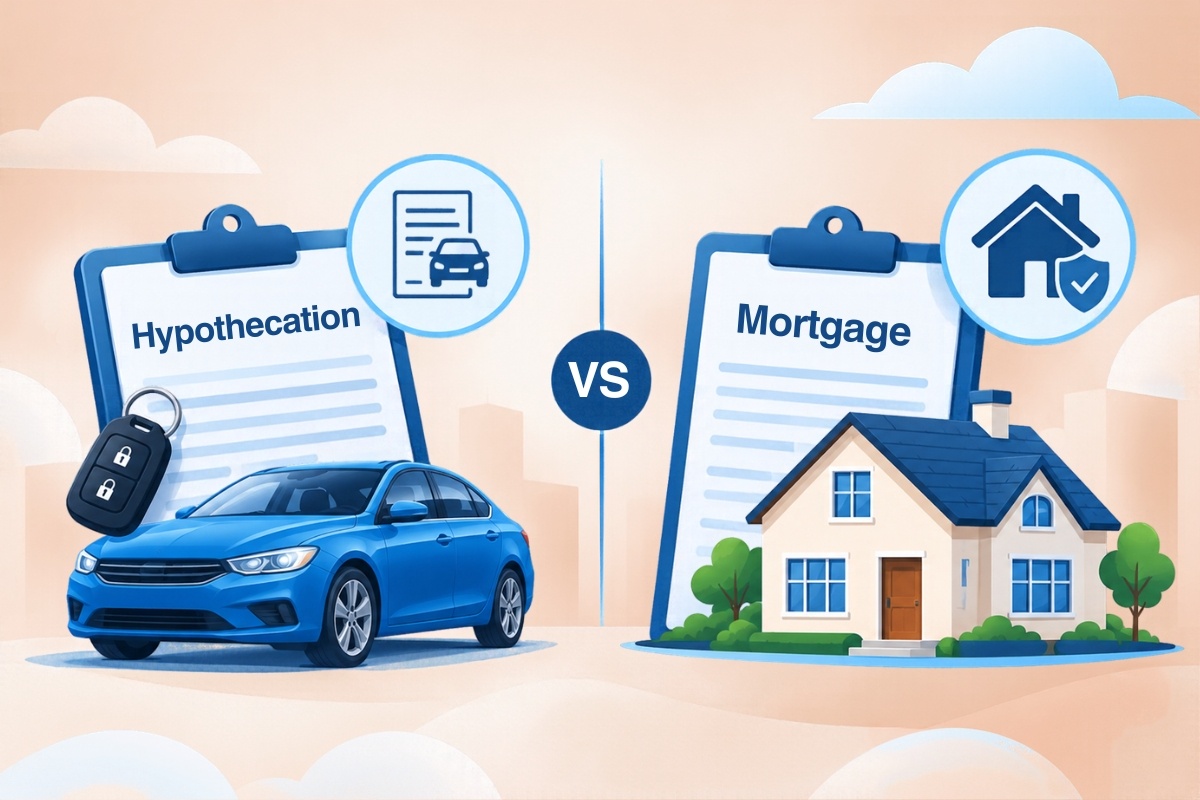
Hypothecation vs mortgage vs pledge
All three arrangements provide security for borrowing. The key differences concern the asset and possession.
Feature | Hypothecation | Mortgage | Pledge |
Asset type | Movable property, such as vehicles or machinery | Immovable property, such as land or a house | Movable goods or eligible securities |
Possession | Stays with the borrower | Usually stays with the borrower in common home-loan arrangements | Delivered to the creditor, physically or constructively |
Common use | Vehicle and equipment finance; inventory-backed working capital | Home loans and loans against property | Gold loans and loans against shares |
For hypothecation vs mortgage, the main distinction is movable versus immovable property. Possession alone is not enough to distinguish them, because homeowners commonly continue living in mortgaged homes.
For hypothecation vs pledge, possession or control matters. Gold may be physically held by the creditor. A securities pledge can be recorded electronically, without paper certificates changing hands.
The agreement’s legal structure matters more than the informal label used in conversation.
What assets can be hypothecated?
Depending on the financing arrangement, eligible security may include:
- Cars, two-wheelers and commercial vehicles.
- Machinery and movable business equipment.
- Raw materials, work in progress and finished inventory.
- Receivables or book debts, where the security structure permits.
Securities require a closer look because the arrangement may instead use a pledge. Receivables may also be secured through an assignment, depending on the transaction.
Asset eligibility is not automatic. Finance providers assess ownership, valuation, existing claims and the ability to enforce their security. The sanctioned amount may be lower than the asset’s stated value.
Hypothecation charge and how to remove it
A hypothecation charge is the security interest created over the asset. Here, “charge” does not necessarily mean a fee. Documentation, registration or service fees are separate and should be checked in the applicable schedule.
For a financed vehicle, the RC records the financier’s interest. Paying the final instalment and updating that record are separate tasks.
How to remove hypothecation from RC
1. Confirm closure. Check that the vehicle loan, interest and other outstanding dues are fully cleared. PayMe’s guide to checking your car loan balance can help you verify the account position.
2. Collect release documents. Request the financier’s NOC or due-clearance confirmation and the required Form 35 documentation.
3. Check your state RTO requirements. Confirm supporting documents, signatures, applicable fees and whether you can apply through VAHAN or must visit the office.
4. Submit and track the application. Complete verification and check the updated RC once the termination is approved.
Parivahan identifies Form 35 and clearance documentation in its guidance. Supporting requirements vary by state, so avoid relying on a universal document checklist or processing timeline.
Keep the closure letter, NOC and updated RC safely. Confirming the entry has been removed can help prevent documentation delays when you later sell or transfer the vehicle.
Advantages and disadvantages
Advantages | Disadvantages |
You retain possession and can use the asset during repayment. | You risk repossession and sale if repayment fails. |
Security may support competitive pricing, depending on eligibility and the product. | A lower interest rate is not guaranteed; fees also affect cost. |
Businesses can use financed equipment or inventory to support operations. | Insurance, reporting and maintenance conditions may apply. |
An eligible movable asset can help support access to credit. | Selling or transferring the asset may require consent or release. |
Judge the arrangement against your monthly budget. Keeping the asset in use is valuable only if repayments remain manageable.
Legal aspects in India
Section 2(1)(n) of the SARFAESI Act, 2002 defines this security arrangement as a charge over movable property without delivery of possession to the secured creditor.
The contract sets out the parties’ obligations within the applicable legal framework. SARFAESI enforcement is subject to statutory eligibility, conditions and exclusions; it does not apply identically to every loan.
Vehicle records also fall under motor vehicle law. Pledges are separately addressed by the Indian Contract Act, 1872.
For NBFC vehicle finance, RBI guidance requires enforceable repossession clauses and transparent procedures in the agreement. Read these terms before borrowing and retain a copy.
Frequently Asked Questions
What is hypothecation in simple words?
What is the difference between hypothecation and mortgage?
What is the difference between hypothecation and pledge?
What assets can be hypothecated?
How do I remove hypothecation from my RC?
Is hypothecation good or bad for a borrower?
About the Author
Himanshu Mishra
@himanshu.mishra@paymeindia.in
View all posts →