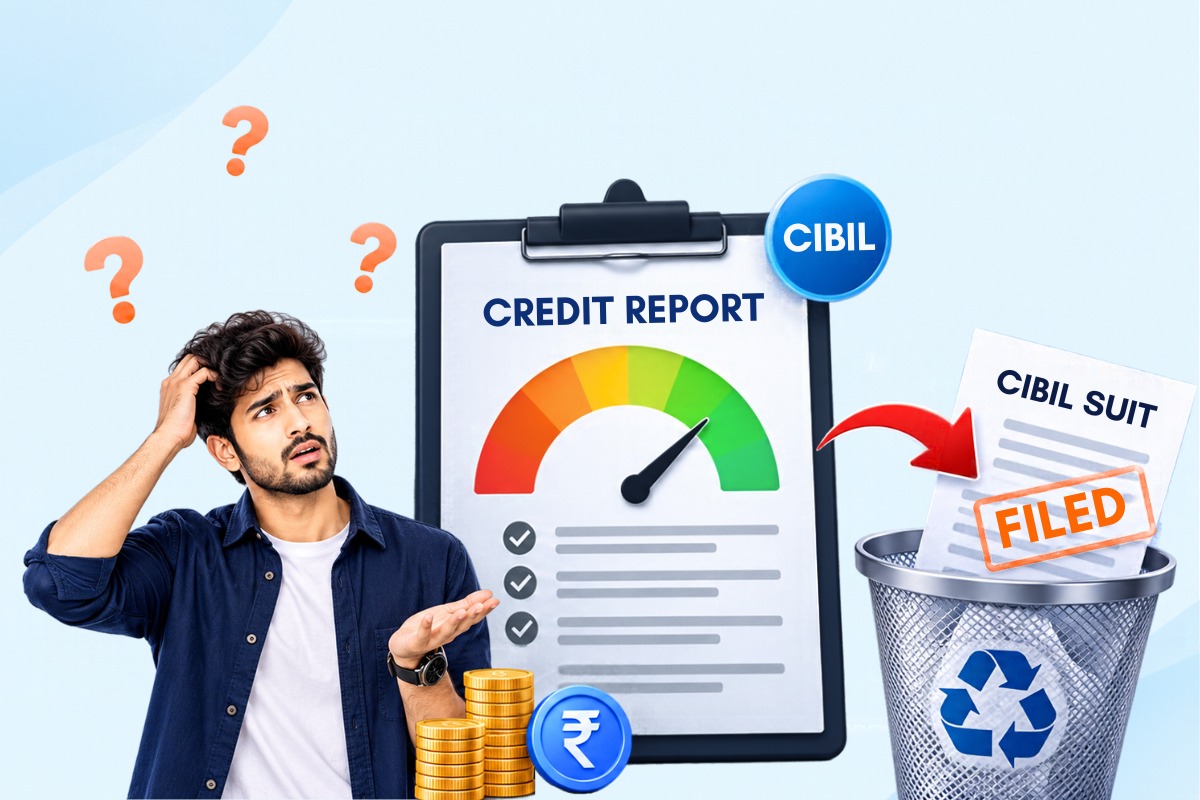
How to Remove ‘Suit Filed’ Status From Your CIBIL Report
❤️ Spread the Love
Quick Answer: To address a ‘suit filed’ entry, contact the lender to verify the case, resolve valid dues and obtain repayment and case-resolution documents. Ask the lender to update your credit report. If the entry is incorrect or outdated, raise a dispute with CIBIL. Repayment alone does not automatically remove an accurate legal remark.
You open your credit report expecting to check a number. Instead, two words catch your attention: “suit filed”. Perhaps the loan is still overdue. Perhaps you have already paid it off and assumed the matter was closed.
Repayment, account closure and resolution of a legal case are separate things. Your report needs to reflect the correct position.
Before applying for another loan, understand what this remark means, whether it is accurate and what you need to do next.
What is a ‘suit filed’ status in CIBIL?
A “suit filed” status indicates that a lending institution has reported filing legal proceedings to recover unpaid borrowing. CIBIL records information supplied by financial institutions; it does not file the case against you.
The remark is different from an ordinary overdue payment. Missing an instalment does not, by itself, establish that a suit has been filed.
Check the actual value beside the relevant field in your report. A heading that combines legal-action and default categories is not confirmation that every category applies to your account.
If the entry seems unfamiliar, check the account number and reporting institution before taking any action.
Also Read: What Is APR in a Personal Loan?
Why do lenders file a CIBIL suit?
The expression “CIBIL suit” refers to legal recovery proceedings concerning a debt, with the resulting information reported to the credit bureau.
A creditor may pursue recovery after prolonged non-payment, unsuccessful repayment discussions or unanswered notices. The outstanding amount, loan agreement and circumstances influence its decision.
There is no universal rule that a fixed number of missed EMIs automatically triggers a lawsuit. Similarly, receiving a payment reminder does not necessarily mean a case has been filed.
Read legal notices promptly. If you are unsure what a notice requires, seek legal advice rather than leaving it unanswered.
What a suit filed status does to your credit
It can lower your credit score
The missed payments and default associated with legal recovery can damage your credit score. The impact depends on your overall borrowing history; there is no reliable fixed points deduction that applies to everyone.
Repayment can help address the account, but earlier payment delays may remain relevant. Do not expect your score to recover immediately after paying the dues or requesting a correction.
Loan and card rejections
An adverse legal remark can make approval difficult because it raises concerns about repayment. Financial institutions assess your report alongside income, existing obligations and their credit policies.
Even if your income has improved, an unresolved entry may affect how an application is assessed. Correcting inaccurate information allows institutions to review the right facts, but it does not guarantee approval.
Higher rates and tougher terms
Where borrowing remains available, an institution may offer a smaller amount or less favourable terms.
Compare the total borrowing cost and repayment obligation carefully. Taking expensive credit while resolving an older debt can create another affordability problem, especially if your monthly budget is already stretched.
How to remove ‘suit filed’ from CIBIL
Start by separating two situations: an incorrect entry and a genuine case that needs resolution.
If the account does not belong to you, challenge it immediately. You should not pay an unfamiliar debt simply to make a remark disappear.
For a genuine account, the process involves resolving the dues, establishing the position of the legal case and requesting accurate reporting. Follow these six steps.
Also Read: Flat vs Reducing Interest Rate
1. Get your CIBIL report
Download the full report rather than relying on a score screenshot or a brief summary in an app.
Locate the relevant account and note:
The reporting institution’s name.
The account number.
The outstanding balance and overdue amount.
The latest reporting date.
The exact legal-action remark.
Compare these details with your loan documents and payment records. Look for duplicate accounts, incorrect balances or borrowing you do not recognise.
Eligible consumers can access one free full report each calendar year. Keep a dated copy so you can compare the information after a correction.
2. Contact the lender
Write to the institution shown against the account. Ask it to confirm whether proceedings were actually filed and request the case reference.
Also ask for the current dues, including any charges being claimed, and whether the case is pending, withdrawn or otherwise disposed of.
If you have already repaid the loan, explain the mismatch clearly. Mention the payment date and provide the relevant receipts or closure documents.
Ask what information has been reported to the bureau and whether an update is required. Keep written responses and acknowledgements rather than relying only on verbal assurances from a collection representative.
3. Pay the outstanding dues
If the debt is valid, obtain a written repayment or closure proposal before paying. Check the amount, payment deadline, authorised payment channel and treatment of any pending case.
Where affordable, full repayment avoids the separate reporting issue that can arise when you pay less than the total amount owed.
A negotiated settlement may be necessary in some circumstances, but “settled” and “closed” are different account outcomes. Ask how the arrangement will be reported before accepting it.
Keep every payment receipt. Paying the agreed amount does not automatically establish that court proceedings have ended.
4. Get a No Dues Certificate
After completing the agreed payment, request a No Dues Certificate or equivalent closure document. Check that it identifies your account and accurately states the repayment outcome.
Separately, obtain documentary confirmation of the legal case’s resolution, such as the relevant withdrawal or disposal order where applicable.
A certificate confirming that no dues remain does not, by itself, establish that a pending case has ended.
Ask the institution to update the balance, closure details and legal reporting as appropriate. If it says the historical remark remains accurate, request a written explanation of what can be updated.
5. Raise a dispute with CIBIL
If information is wrong or has not been updated correctly, use CIBIL’s official dispute process.
Sign in, open your credit report and select the relevant account or field in the dispute centre. Describe the specific correction you seek.
For example, “The outstanding balance is incorrect after repayment” gives a clearer explanation than “Please improve my score”.
Keep payment receipts, closure documents and case-resolution records ready, and provide them through the channels requested.
CIBIL must verify changes with the reporting institution. It cannot independently delete an accurate record simply because you request removal.
6. Track and re-check
Save the dispute ID and follow the response. Once the complaint is resolved, inspect the updated report; complaint closure does not mean every field changed.
Check the balance, overdue amount, account status and disputed legal remark. If the response does not address your evidence, escalate through the institution’s and bureau’s grievance channels.
Credit-information correction complaints have a 30-day resolution framework. Eligible delays beyond 30 calendar days can attract ₹100 per calendar day in compensation, subject to the applicable rules and exclusions.
This timeline concerns complaint resolution. It does not guarantee withdrawal of a legal case or deletion of an accurate entry.
Also Read: Prepayment vs Part-Payment vs Foreclosure
Suit filed vs willful default
These terms describe different issues and can appear together.
Status | What it means |
Suit filed | Legal proceedings have been filed to recover the debt. |
Wilful default | A formal classification under RBI rules involving specified circumstances, such as default despite repayment capacity, diversion or siphoning of funds. |
Financial hardship does not automatically make someone a wilful defaulter. Classification requires the prescribed assessment and process.
Similarly, a legal recovery case does not automatically establish wilful default. If your report contains both remarks, ask for clarification of each and challenge any inaccurate reporting separately.
How to avoid a CIBIL suit
Keep repayment dates visible and maintain sufficient funds for scheduled debits. If income drops or an emergency disrupts your budget, contact the creditor before arrears grow.
Ask whether a revised repayment arrangement is available and get approved terms in writing. Restructuring is subject to approval and may affect reporting.
Review account statements, respond to notices and retain payment records. Addressing repayment difficulties early gives you more time to discuss available options.
If an account is already overdue, focus on resolving it and correcting inaccuracies before taking on further borrowing.
Disclaimer: This article provides general information and is not financial or legal advice. Reporting updates depend on verified account facts and applicable rules. For an active legal case, consult a qualified legal professional. Loan approval is subject to eligibility and the lending institution’s assessment.
Frequently Asked Questions
How long does a suit filed entry remain on a CIBIL report?
What is the difference between ‘suit filed’ and ‘willful default’?
Can a suit filed entry be removed after a one-time settlement?
How long does CIBIL take to update after a dispute?
Can I get a loan while a suit filed entry is active?
What documents do I need to dispute a suit filed entry?
About the Author
Himanshu Mishra
@himanshu.mishra@paymeindia.in
View all posts →