CMR Full Form in CIBIL: Meaning, Ranks and How to Improve
❤️ Spread the Love
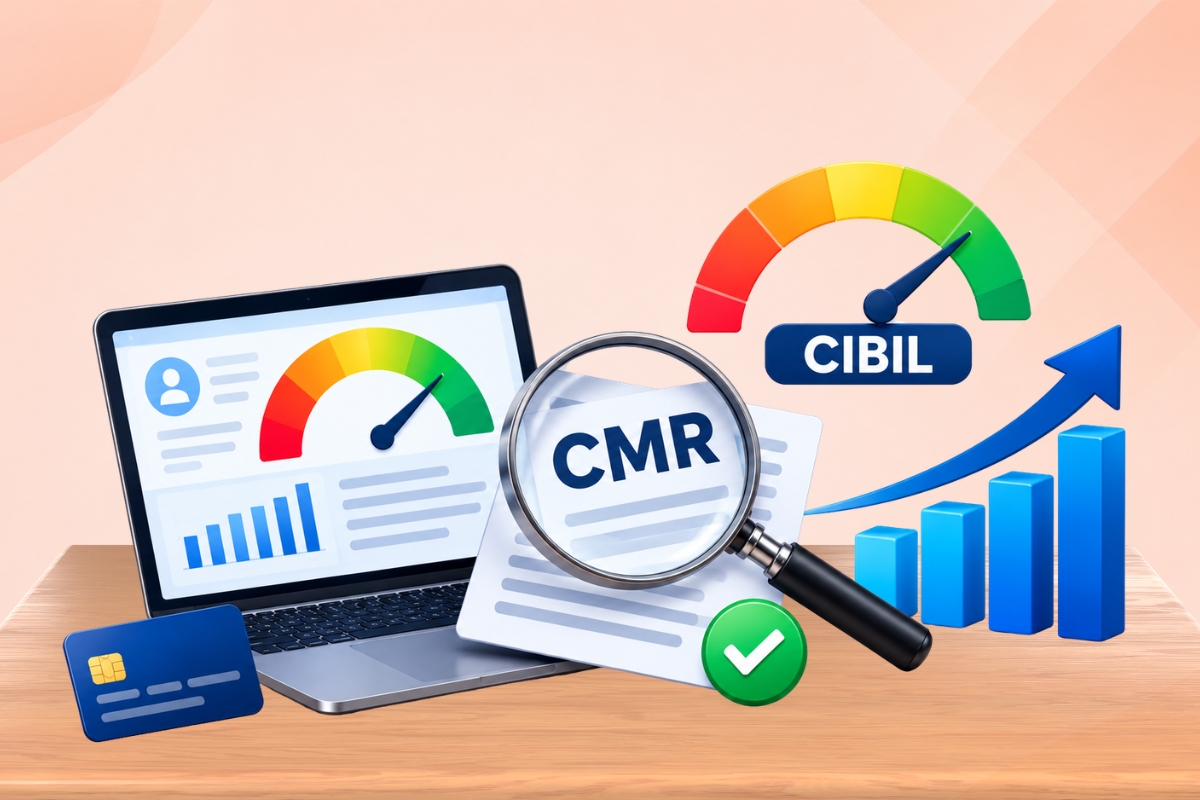
Quick answer: CMR stands for CIBIL MSME Rank. It ranks eligible businesses from 1 to 10, with 1 indicating the lowest credit risk and 10 the highest. Lenders use it to assess business creditworthiness, alongside other checks. A lower number is better, but it does not guarantee loan approval.
You apply for a working capital loan, send the documents and hear back: “We also need to check your CMR.” If you have only checked your personal credit score before, that unfamiliar abbreviation can leave you wondering what the bank has found.
The CMR full form in CIBIL is CIBIL MSME Rank. It helps assess a business’s borrowing behaviour. And unlike the personal score you may already know, the aim here is to move towards a smaller number.
What is CMR in CIBIL?
CIBIL MSME Rank is a credit risk indicator developed by TransUnion CIBIL for micro, small and medium enterprises. It estimates the likelihood of default over the next 12 months using the borrowing entity’s credit profile. It applies to business credit, rather than an individual’s personal borrowing.
The enhanced model covers eligible entities with aggregate commercial credit exposure up to ₹50 crore, including those below ₹10 lakh. Exposure here concerns commercial borrowing across credit institutions; it is not the business’s turnover. The older ₹10 lakh minimum should therefore not be treated as the current entry threshold.
Think of the rank as a starting point for a credit discussion. It helps a financier assess risk, but cannot explain every aspect of how a business earns, spends or manages seasonal demand.
Also, a bureau-based rank differs from a rating issued by a credit rating agency. For that separate concept, see PayMe’s guide to credit rating agencies in India.
How is the CMR rank calculated?
The calculation draws on commercial credit information reported by lending institutions. CIBIL’s published guidance describes an assessment using the previous 24 months of the business’s credit history. Relevant considerations include:
Payment behaviour: Whether instalments and other credit obligations are paid on time, with attention to overdue amounts and defaults.
Credit utilisation and liquidity: How the business uses its available borrowing limits.
Credit history: The length and pattern of borrowing relationships and credit behaviour.
There is no public do-it-yourself formula. Personal score calculation percentages should not be copied into a business credit assessment.
For example, two firms can have similar sales but different borrowing records. One may service its loans consistently; the other may repeatedly fall behind. Their turnover alone would not explain their credit risk.
What each CMR rank (1 to 10) means
The CMR score range is 1 to 10, although “rank” is the more accurate term. Risk rises as the number increases. The bands below are a broad reading guide, using the groupings shown in CIBIL’s published CMR material—not universal loan approval cut-offs.
Rank band | Broad risk interpretation | What it may mean during assessment |
CMR-1 to CMR-3 | Lower-risk end of the scale | A more favourable indicator; may support access to better terms |
CMR-4 to CMR-7 | Intermediate band | Requires closer reading of the report and the wider application |
CMR-8 to CMR-10 | Higher-risk end of the scale | Greater credit concerns; financing may be harder to obtain |
Within the scale, CMR-1 is the least risky and CMR-10 the most risky. A rank of 4 is therefore better than 6, even though both appear in the same broad band.
A good CMR score generally refers to the lower end, particularly ranks 1 to 3. However, an individual rank does not prove that every account is overdue-free or predict a certain rejection. Ask the bank which eligibility conditions apply to the product you want.
CMR vs your personal CIBIL score
Your business credit rank and your personal CIBIL score answer different questions. The first concerns business borrowing; the second summarises an individual’s credit history. A personal score ranges from 300 to 900, with a higher number indicating a stronger credit profile.
Point of comparison | Business rank | Personal CIBIL score |
Who it assesses | Eligible business borrowing entities | Individual borrowers |
Numeric range | 1–10 | 300–900 |
Better direction | Lower | Higher |
Associated report | Company Credit Report | Individual Credit Information Report |
For a small firm, both may be relevant. Depending on the business structure and loan terms, the financier may also assess a proprietor’s or guarantor’s personal credit history. A strong personal record should not be assumed to cancel out problems in business accounts.
PayMe’s explanation of how scores are calculated provides further context on personal credit scoring. Keep those factors separate from the commercial ranking model.
How to check your CMR rank
Use CIBIL’s official CIBIL Rank and Company Credit Report service, rather than a personal score checker.
Select the business report service and review the available plans and charges.
Complete registration with the business details and verification documents requested.
Access the report after the required checks are completed.
Review the rank alongside the account-level information.
Check balances, account status, payment history and working capital utilisation. Save a copy for later comparison.
If a rank is unavailable, do not automatically read that as poor creditworthiness. CIBIL explicitly says non-availability is not a negative indicator; the Company Credit Report can still help you review the borrowing record.
How to improve your CMR rank
Start with the accounts behind the number. These steps support a healthier borrowing record, although no action guarantees a particular rank change.
Protect payment dates. Maintain a calendar for installments and credit facility dues. If collections tend to arrive late, plan a buffer before the due date. An automatic debit still needs sufficient funds in the account.
Address existing overdues. Ask the bank for a clear account statement and discuss how to regularise pending payments. Keep receipts and relevant correspondence, then check whether subsequent reporting reflects the correct position.
Watch working capital usage. Review whether borrowing limits remain heavily used month after month. As a practical cash flow check, compare collections, stock purchases and upcoming payments to identify why the business keeps relying on the limit. CIBIL recommends keeping usage within available limits and avoiding maxing out credit lines.
Keep financial records organised. Up-to-date bank statements, tax filings and financial statements help explain the business’s position during assessment. Accurate books support better decisions; they are not a shortcut that directly changes a bureau rank. Borrow only what the business can realistically service.
Correct reporting errors. Check for duplicate facilities, unfamiliar accounts or incorrect balances. CIBIL allows businesses to raise commercial report disputes and does not charge for that service. Keep supporting documents ready. A dispute addresses inaccurate information; it is not a way to remove a valid borrowing record.
Review progress through updated reports. Avoid planning a loan application around promises of an instant improvement or a fixed number of ranks gained.
For a separate personal borrowing need, explore PayMe’s personal loan information and review eligibility, total cost and repayment terms before applying.
Frequently Asked Questions
What is the full form of CMR in CIBIL?
What is a good CMR score?
Is CMR the same as my CIBIL score?
Does a low CMR rank mean loan rejection?
What is the CMR range?
How can I improve my CMR rank?
About the Author
Himanshu Mishra
@himanshu.mishra@paymeindia.in
View all posts →